What it looks like
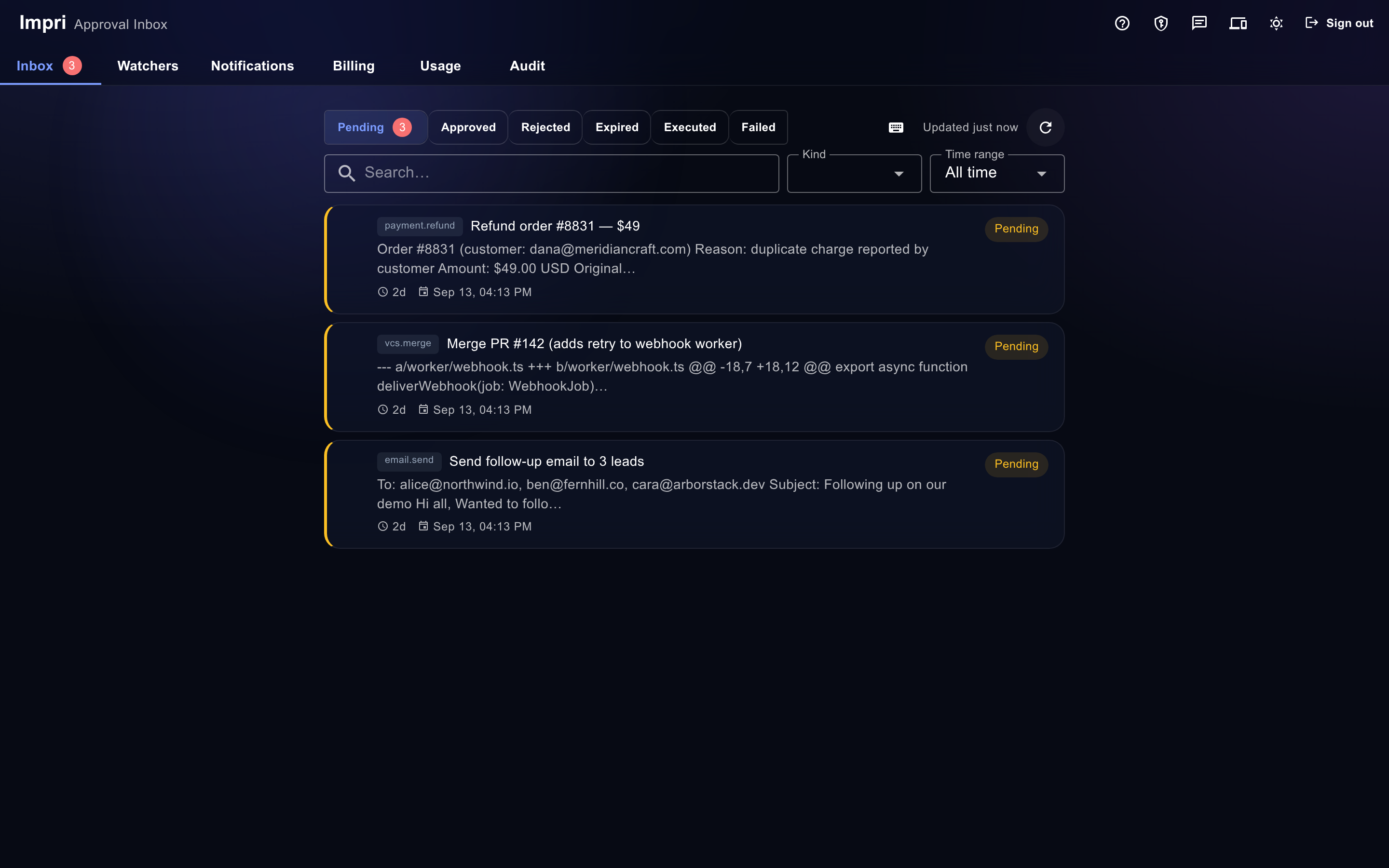
An AI support agent that can look up an order, understand the complaint, and decide a refund is warranted is genuinely useful — most refund requests are routine and the reasoning is easy to check. The part worth gating isn't the judgment call, it's the money actually moving.
A support agent that's right 98% of the time about refund amounts is still wrong roughly once in fifty. At volume, "wrong" here means real charge-backs, real disputes, real reconciliation work, and a customer who got refunded twice or not at all. Refunds also invite a specific failure mode agents are bad at resisting: a customer arguing forcefully for a bigger refund than policy allows, phrased as if it were already agreed.
impri_push_action with the order ID, amount, and reason as the preview — not the refund API call itself.impri_await_decision returns the (possibly edited) amount; the agent calls the payment processor's actual refund endpoint only with that approved figure.impri_report_result closes the loop with the processor's transaction ID, so the audit log ties every refund back to the decision that authorized it.
impri_push_action({
  kind: "payment.refund",
  title: "Refund $84.00 to order #10432 — damaged item, customer provided photos",
  preview: {
    format: "plain",
    body: "Order #10432, $84.00 full refund. Customer: item arrived cracked, photo attached to ticket #6021."
  },
  payload: { order_id: "10432", amount_cents: 8400, currency: "USD" },
  target_url: "https://support.acme.com/tickets/6021",
  editable: ["payload.amount_cents"]
})
// -> { action_id: "act_5jf8...", status: "pending", inbox_url: "https://app.impri.dev/inbox/act_5jf8..." }

impri_await_decision({ action_id: "act_5jf8...", timeout_s: 1800 })
// -> { action_id: "act_5jf8...", status: "approved", decision_at: 1757830200, preview: { format: "diff", body: "..." }, edited_by_human: false }

impri_report_result({
  action_id: "act_5jf8...",
  status: "executed",
  detail: "Refunded via Stripe, txn re_1P..."
})Routine, in-policy refunds still flow at the speed a support agent promises. Every refund that's large, unusual, or contested gets a human looking at the actual amount and reason before money moves — and a paper trail that shows exactly who authorized it.